Last updated: 2026-03-31
TL;DR
- Most marketing reports track activity, not outcomes. This checklist tracks what matters.
- 15 specific checks across revenue, channels, content, technical health, and pipeline.
- Each check includes what to look at, where to find it, and what action to take.
- Spend 2 to 3 hours monthly on this. It replaces vague agency reporting.
- If you cannot answer these 15 questions, you do not understand your marketing.
Why Most Monthly Reports Are Useless
We have reviewed marketing reports from over 250 clients across 15 years. The overwhelming pattern: agencies and internal teams report activity, not outcomes. Pages of graphs showing impressions trending up, click-through rates holding steady, social followers growing. None of it connected to revenue.

The problem is not that people track too little. Most businesses are drowning in dashboards. The problem is that they track the wrong things, or they track the right things without acting on what they find. A monthly marketing review should take 2 to 3 hours, cover 15 specific checks, and produce a short list of actions. Not a 40-slide deck that nobody reads.
What follows is the exact checklist we use with clients through our Fractional CMO service. It is organised into 5 categories, each containing 3 checks. Run through all 15 once a month and you will know more about your marketing than most CMOs learn from their teams’ reports.
Category 1: Revenue Attribution (Is Marketing Making Money?)
Check 1: Revenue by marketing channel, with full cost loaded
Open your CRM (HubSpot, Salesforce, Pipedrive, whatever you use) and pull closed-won revenue for the past 30 days, broken down by the original source channel. Then load in the full cost for each channel: ad spend, tool costs, and a fair allocation of the team time or agency fees that went into running it.
You want a simple table. Revenue on one side, fully loaded cost on the other, ROAS or cost per acquisition in the final column. If a channel cannot show a positive or improving trajectory over 3 months, it needs a hard conversation.
| Channel | Revenue (30 days) | Fully Loaded Cost | ROAS | Trend vs. Prior Month |
|---|---|---|---|---|
| Paid Search | £42,000 | £8,500 | 4.9x | ▲ +0.3x |
| SEO / Organic | £31,000 | £4,200 | 7.4x | ▲ +0.8x |
| Paid Social | £12,500 | £6,800 | 1.8x | ▼ -0.4x |
| £18,000 | £1,100 | 16.4x | ► Flat | |
| Referral | £9,500 | £600 | 15.8x | ▲ +2.1x |
The example above is illustrative, but notice what it reveals instantly. Paid social is expensive relative to return and trending down. Email and referral are cheap and high-performing. These are the conversations that matter.
Check 2: New customer acquisition cost (CAC) versus lifetime value (LTV)
Pull your blended CAC for the month: total marketing spend divided by new customers acquired. Compare it to your average customer LTV. According to ProfitWell’s 2025 SaaS benchmarking data, a healthy LTV:CAC ratio sits between 3:1 and 5:1. Below 3:1 and you are spending too much to acquire. Above 5:1 and you may be under-investing in growth.
Check 3: Attribution model accuracy
Whatever attribution model you use (last-click, linear, data-driven), spot-check it monthly. Pick 5 to 10 recently closed deals and manually trace their journey. Did the attribution model credit the right channel? GA4’s data-driven attribution, introduced fully in 2023 and refined through 2025, is better than last-click but still misses offline touchpoints, dark social, and word-of-mouth.
If your manual spot-check disagrees with the model more than 30% of the time, your reporting numbers are unreliable. Acknowledge it and adjust decisions accordingly rather than pretending the data is gospel.
Category 2: Channel Health (Are Your Channels Working?)
Check 4: Paid media efficiency by campaign tier
Do not just look at account-level ROAS. Break it down by campaign tier: brand campaigns, non-brand search, prospecting social, retargeting. Brand campaigns always look efficient because they capture existing demand. The real question is whether your prospecting and non-brand campaigns are generating new demand at an acceptable cost.
According to WordStream’s 2024 Google Ads benchmark report, the average cost per conversion across industries is $56.11 USD for search and $72.09 USD for display (as of Q4 2024). If your non-brand search campaigns are significantly above your industry benchmark and not improving, something is wrong with your targeting, landing pages, or offer.
Pull Quality Score distribution while you are in the ad accounts. A healthy account has 70%+ of active keywords at Quality Score 7 or above.
Check 5: Organic search visibility and ranking movement
Open Google Search Console and compare impressions, clicks, and average position for the past 30 days against the previous 30 days. Then open your rank tracking tool (Ahrefs, SEMrush, or Sistrix) and check:
- How many target keywords moved up vs. down vs. stayed flat.
- Whether any high-value keywords dropped more than 5 positions (this signals a problem).
- Whether any new keywords entered the top 20 (this signals growing topical authority).
Google’s March 2025 core update reinforced the pattern: sites with thin, AI-generated content at scale lost visibility, while sites with original research and clear expertise gained. If your organic traffic is declining, check whether competitors have published more comprehensive content on your core topics.

Check 6: Email engagement and list health
An email list that is not regularly cleaned is a liability, not an asset. Check these 3 numbers monthly: open rate trend, click-to-open rate trend, and unsubscribe rate. According to Campaign Monitor’s 2025 email benchmarks, the average open rate across industries is around 21.5% and average click-through rate is 2.3%.
More important than the absolute numbers: are they trending up or down? A declining open rate over 3 consecutive months usually means your subject lines have gone stale, your send frequency is wrong, or your list needs pruning. Remove contacts who have not opened in 90 days. Your deliverability will thank you.
Category 3: Content Performance (Is Your Content Earning Its Keep?)
Check 7: Top 10 and bottom 10 content pages by conversion
In GA4, pull your top 10 pages by conversions (not pageviews) and your bottom 10 pages that receive traffic but produce zero conversions. The top 10 tells you what is working. Study the format, topic, and intent match. The bottom 10 is where the real insight lives: these pages attract visitors but fail to convert them. Why?
Common culprits: missing or weak calls to action, content that answers informational queries with no logical next step, outdated information that erodes trust, or pages that rank for the wrong intent entirely. Fix 2 to 3 of your bottom performers each month. This is higher-ROI work than writing new content.
Check 8: Content decay detection
Content decay, the gradual decline of a once-performing page, is one of the most overlooked issues in content marketing. Animalz’s research on content decay found that the average blog post begins declining 6 to 12 months after publication if not updated.
Run this check monthly: pull any page that has lost more than 20% of its organic traffic compared to 3 months ago. Prioritise pages that previously drove conversions. For each decaying page, determine whether it needs a content refresh (new data, updated examples), a structural rewrite, or consolidation with another page.
We cover how content fits into broader marketing capability in our three-pillar methodology. Content that decays is content that was published and forgotten. Sustainable marketing requires a maintenance plan.
Check 9: Content gap analysis versus competitors
Pick your top 3 organic competitors (not business competitors, but the sites that rank for your target keywords). Run a content gap analysis in Ahrefs or SEMrush. Identify keywords they rank for that you do not cover at all. If 5+ relevant keywords appear every month that you have no content for, you are falling behind in topical coverage.
The sites that AI models cite most often are those with the broadest, most authoritative coverage of their topic. This matters for Generative Engine Optimisation as much as traditional SEO. Monthly gap analysis keeps you from slowly losing ground without realising it.
Category 4: Technical and Infrastructure Health
Check 10: Site speed and Core Web Vitals
Run PageSpeed Insights on your top 5 landing pages monthly. Check both mobile and desktop. Google’s Core Web Vitals thresholds as of 2026 are: Largest Contentful Paint (LCP) under 2.5 seconds, Interaction to Next Paint (INP) under 200 milliseconds, and Cumulative Layout Shift (CLS) under 0.1.
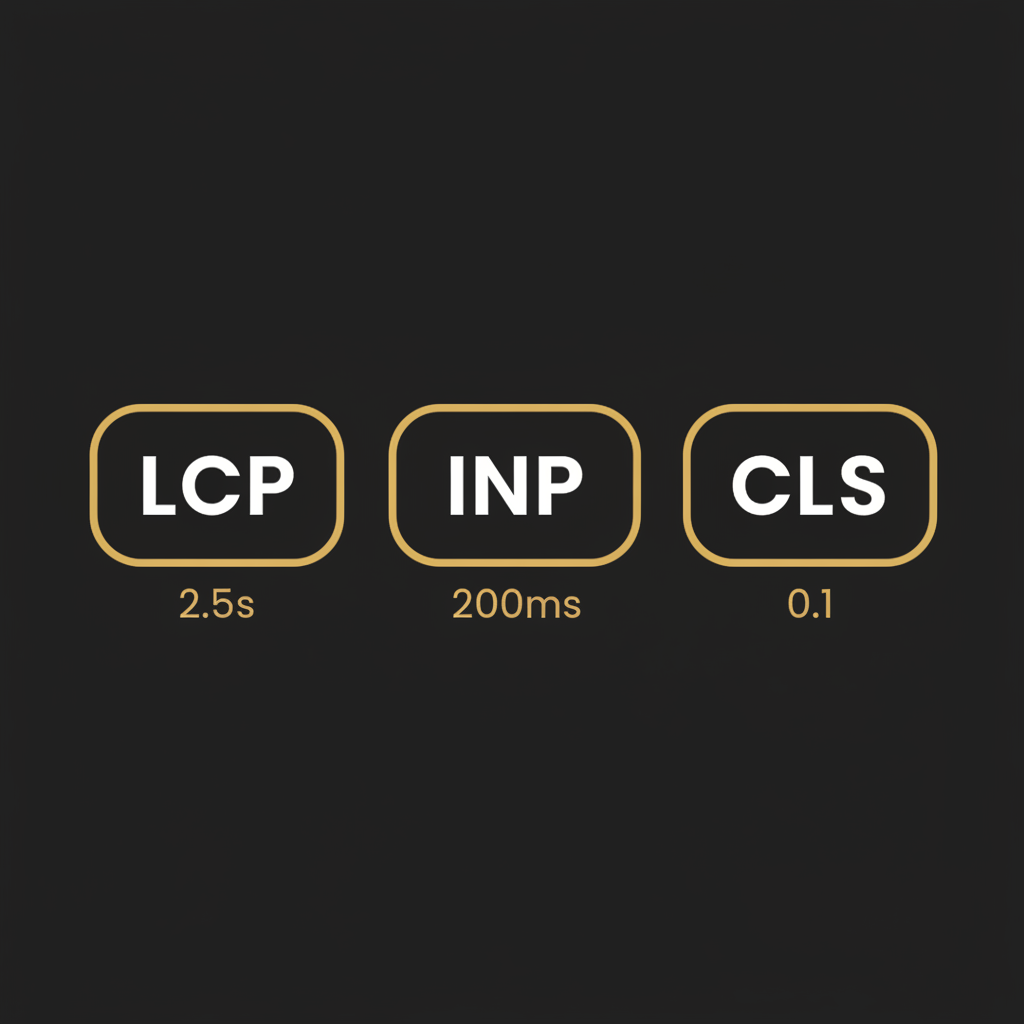
A page that was fast 3 months ago might not be fast today. New scripts get added. Images creep in without compression. Third-party tags accumulate. According to Google’s Web Vitals documentation (updated 2025), pages meeting all three thresholds are 24% less likely to see user abandonment than pages that fail any single metric.
Check 11: Tracking and tag accuracy
This is the check everyone skips and then regrets. Open Google Tag Manager (or your tag management system) and verify:
- All conversion tags are still firing on the correct pages (use GTM’s preview mode).
- No duplicate tags have been added (this inflates conversion counts).
- Server-side tagging is still functioning if you use it (check your server container logs).
- Consent management is not blocking tags for users who have consented.
We see broken tracking at least once per quarter across the clients we work with. A single misconfigured tag can make an entire month of data unreliable. Five minutes of checking prevents a month of bad decisions.
Check 12: CRM data hygiene
Your CRM is only as good as the data inside it. Monthly, check for: duplicate contacts (merge them), leads with missing source attribution (trace and fix), and pipeline stages with contacts that have been stuck for over 30 days (either progress them or disqualify them).
Dirty CRM data is the number one reason marketing and sales teams disagree about lead quality. If marketing says they sent 50 qualified leads and sales says they only got 20 good ones, the CRM data is usually the missing piece. A clean CRM is a shared source of truth.
Category 5: Pipeline and Commercial Outcomes
Check 13: Marketing-sourced pipeline value and velocity
This is the number your CEO cares about most. How much pipeline value did marketing generate this month? Not leads. Not MQLs. Pipeline: qualified opportunities with an estimated deal value attached.
Track two things: the total value of new pipeline created and the velocity (average days from first touch to opportunity creation). If pipeline value is growing but velocity is slowing, you are attracting interest but struggling to convert it into real conversations. That is usually a nurture or sales handoff problem, not a top-of-funnel problem.
| Metric | This Month | Last Month | 3-Month Average | Direction |
|---|---|---|---|---|
| New Pipeline Value | £185,000 | £162,000 | £170,000 | ▲ Improving |
| Pipeline Velocity (days) | 34 | 31 | 29 | ▼ Slowing |
| MQL to SQL Conversion | 28% | 32% | 30% | ▼ Declining |
| Marketing-Sourced Win Rate | 18% | 19% | 18.5% | ► Flat |
The illustrative data above shows a common pattern: pipeline value up, but quality signals are softening. This would warrant investigation into lead scoring criteria and whether the definition of MQL has drifted.
Check 14: Lead quality feedback from sales
Schedule a 20-minute monthly sync with whoever runs sales. Ask 3 questions: Which marketing leads converted best this month and why? Which leads were worst and why? What are prospects asking about that we are not addressing in our content?
This is not a meeting where marketing defends itself. It is an intelligence-gathering session. Sales teams talk to prospects every day. They know objections, concerns, and competitive dynamics that analytics cannot capture. The best marketing teams treat sales feedback as a primary data source, not an annoyance.
Check 15: Budget pacing and reallocation
Compare actual spend to planned budget. If any channel is significantly under-spending (below 85% of budget), find out why. It could be capacity constraints, approval bottlenecks, or market conditions. If any channel is over-spending without proportional return, flag it immediately.
More importantly, use the data from checks 1 through 14 to make one reallocation decision each month. Move 10 to 15% of budget from your worst-performing channel to your best-performing one. Small, data-informed reallocations compound over time. A business that reallocates monthly will outperform one that sets budgets annually and never adjusts.
If you want to understand how this fits into a broader growth strategy, the principle is simple: review frequently, adjust incrementally, and always follow the data back to revenue.
How to Run This Review in Practice
Fifteen checks sounds like a lot. In practice, once you have the dashboards built, the monthly review takes 2 to 3 hours. Here is how to structure it.
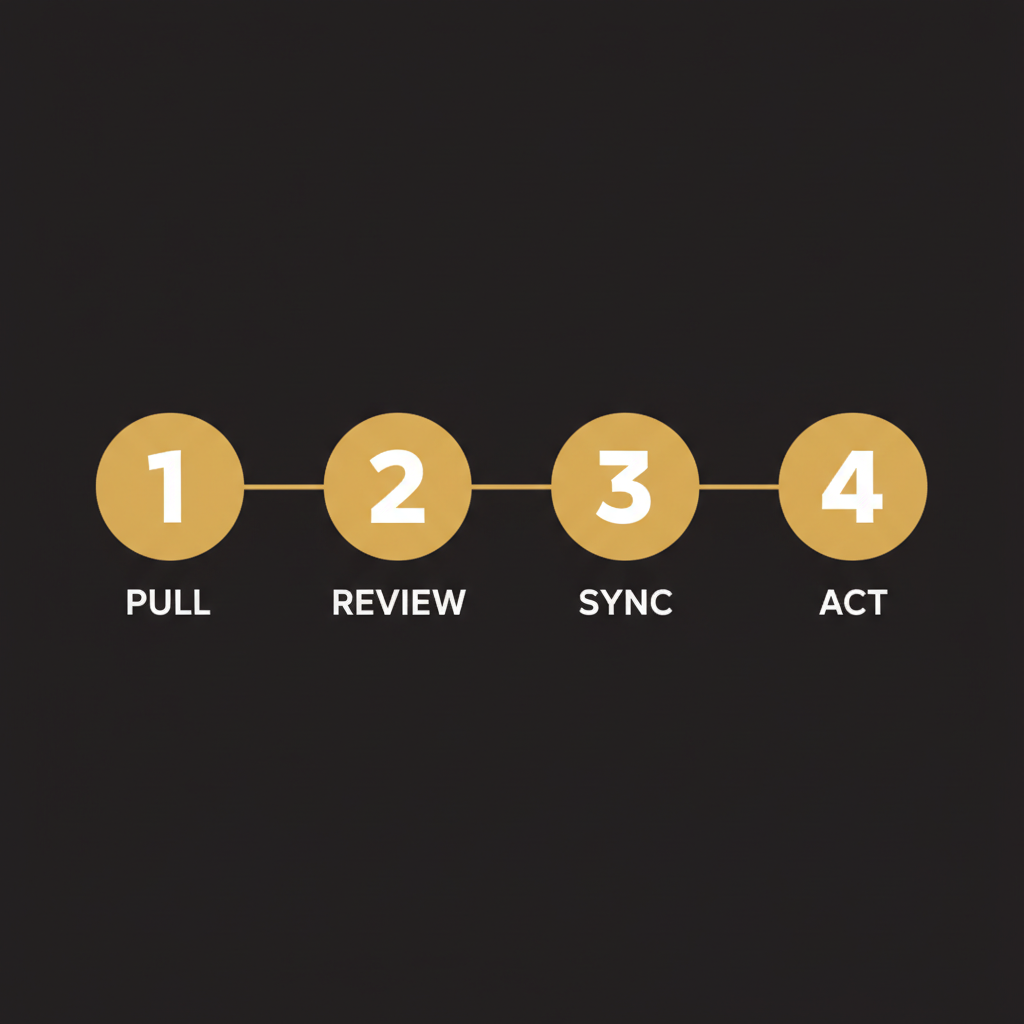
Week 1 of each month: Pull the data. Populate a single-page dashboard or spreadsheet with the numbers for all 15 checks. This should take 45 minutes to an hour once your templates are set up.
Week 1, same day: Review and annotate. Spend 60 minutes reading the data and noting anything that has changed significantly (up or down) from the prior month. Flag items that need investigation.
Week 1 or 2: Sales sync. Twenty minutes. Ask the 3 questions from Check 14.
Week 2: Action list. Based on your review and the sales conversation, produce a list of 3 to 5 specific actions for the coming month. Not goals. Actions. “Refresh the 3 decaying blog posts identified in Check 8” is an action. “Improve content performance” is not.
The discipline is not in the checking. It is in acting on what you find. A review without follow-through is just administration. The difference between good marketing and great marketing is not more data; it is faster, better decisions from the same data.
For businesses that do not have the internal capability to run this review yet, that is exactly the gap a Fractional CMO fills. Not to do the marketing for you permanently, but to build the systems and teach your team how to run them independently.
The Checks Most Businesses Skip (and Regret)
Of these 15 checks, 3 are skipped by nearly every business we audit: attribution model accuracy (Check 3), content decay detection (Check 8), and tracking tag accuracy (Check 11). These are not glamorous. They do not produce impressive-looking charts. But they are the checks that prevent the slow accumulation of bad data that eventually leads to bad strategy.
A client we worked with in 2024 (B2B SaaS, £3M ARR) discovered through Check 11 that their Google Ads conversion tag had been double-firing for 4 months. Their reported CPA was half the actual figure. They had been increasing budget into a campaign that was performing far worse than they believed. Four months of overspend because nobody checked whether the tags were working correctly.
Another common failure: businesses that track content performance by pageviews alone and never run Check 7. They have blog posts getting thousands of visits per month that contribute zero pipeline. Impressive traffic numbers masking zero commercial value. When we redirected their content strategy toward conversion-focused topics, pipeline from organic content increased 40% in 3 months, even as total pageviews dropped 15%.
Frequently Asked Questions
How long should a monthly marketing performance review take?
Once your dashboards and templates are set up, 2 to 3 hours total. The first month will take longer because you need to build the reporting infrastructure. After that, the data pull takes under an hour and the analysis and action planning take 1 to 2 hours.
What tools do I need to run this monthly checklist?
At minimum: GA4 for web analytics, Google Search Console for organic data, your ad platform dashboards (Google Ads, Meta Ads), a CRM with source tracking (HubSpot, Salesforce, or Pipedrive), and an SEO tool like Ahrefs or SEMrush for content gap and rank tracking. Google Tag Manager for tag auditing. Most businesses already have these.
What if I do not have proper attribution set up yet?
Start with last-click attribution in GA4 and basic UTM tracking on all campaigns. It is imperfect but better than nothing. Then work toward a data-driven model and CRM-based attribution over 3 to 6 months. The important thing is to start measuring, even if the measurement is rough.
Should I review weekly instead of monthly?
Weekly monitoring of spend pacing and any active campaigns is sensible. But a full 15-check review works best monthly. Weekly reviews create noise: small fluctuations that do not warrant action. Monthly gives enough data to spot real trends without reacting to randomness.
What is the most important single check if I can only do one?
Check 1: revenue by channel with full cost loaded. If you know how much each channel costs and how much revenue it returns, you can make intelligent allocation decisions. Everything else builds on that foundation.
How do I get my agency to report on these metrics instead of vanity metrics?
Send them this checklist and ask them to restructure their monthly report around it. A good agency will welcome the clarity. An agency that resists reporting on revenue attribution and cost efficiency is an agency that benefits from keeping you in the dark. That tells you something important.
What is content decay and how do I detect it?
Content decay is the gradual loss of organic traffic and rankings to a page that previously performed well. Detect it by comparing each page’s organic traffic to its level 3 months prior. Any page that has lost 20% or more warrants investigation and likely a refresh with updated data, new examples, or expanded coverage.
Do these checks apply to both B2B and B2C businesses?
Yes, with minor adjustments. B2B businesses should weight pipeline and sales feedback checks more heavily (Checks 13 and 14). B2C businesses with shorter sales cycles may focus more on channel efficiency and conversion rate checks. The framework applies to both.
Ready to Build a Marketing Review Process That Actually Works?
If you want to set up this monthly review for your business but need help building the dashboards, training your team, or interpreting the first few rounds of data, that is exactly what we do. We build capability, not dependency.