
Last updated: 2026-03-23
TL;DR
- You can audit your marketing agency using only data you already own.
- Most agency reports are designed to look good, not to tell the truth.
- A 6-point framework covers spend, results, access, reporting, contracts, and strategy.
- Red flags include restricted platform access, vague KPIs, and bundled billing.
- The goal is not to fire your agency. It is to know whether you should.
Why Most Agency Audits Are Worthless
The typical agency “audit” goes something like this. You ask your agency how things are going. They send you a PDF with graphs trending upward. You nod, pay the invoice, and repeat next month. That is not an audit. That is a bedtime story.
Agencies control the data they show you. They choose the date ranges, the metrics, and the benchmarks. A report that says “impressions up 34%” means nothing if conversions dropped and cost per acquisition doubled. An audit you cannot verify independently is not an audit at all.
This is not about distrust. It is about accountability. Even good agencies benefit from informed clients. The ones that resist scrutiny are the ones you should worry about. Over 15 years and 250+ client engagements, the pattern is consistent: the agencies doing the best work are the ones who welcome an independent review.
The problem is that most founders do not know where to look. They rely on the agency’s own reporting because they think the alternative is hiring another agency or an expensive consultant. It is not. You can do this yourself in a single afternoon.
What You Should Actually Be Auditing
Before you start pulling reports, you need to know what matters. Most businesses fixate on surface metrics: impressions, clicks, followers. Those are activity metrics. They tell you that something happened. They do not tell you whether that something was worth paying for.
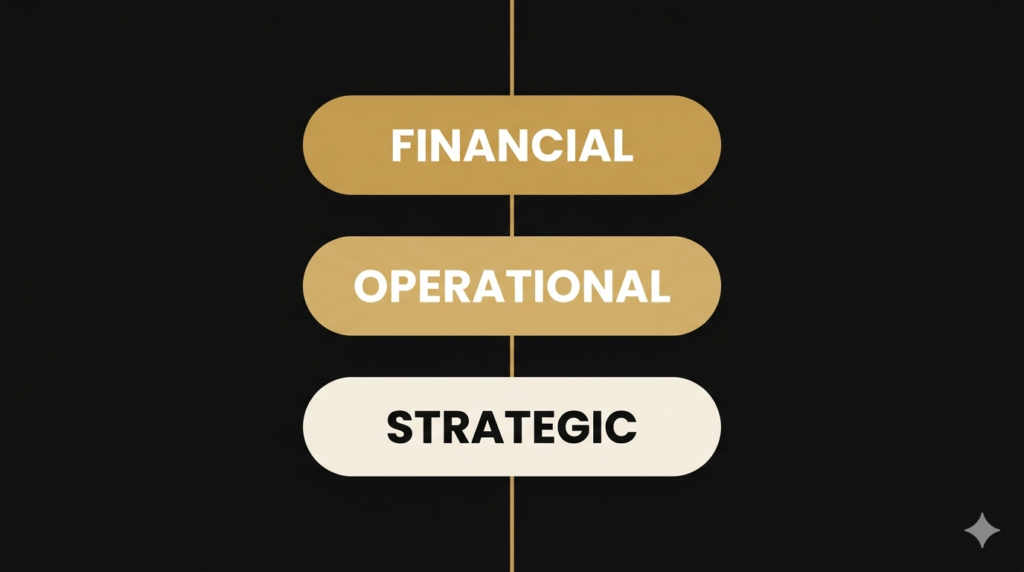
There are 3 layers to any meaningful agency audit: financial, operational, and strategic. Financial covers what you are paying versus what you are getting back. Operational covers how the work is being done, who owns what, and how transparent the reporting is. Strategic covers whether the agency’s plan actually connects to your business goals or just to their retainer.
Financial Layer
This is the simplest starting point. How much are you paying in fees? How much is going to media spend? What is the blended Return on Ad Spend (ROAS) across all paid channels? If you cannot answer these 3 questions from memory, your agency’s reporting is failing you.
Operational Layer
Do you own your ad accounts, your analytics, your domain, your CRM data? If your agency set up accounts under their own logins, you have a dependency problem. If they left tomorrow, could you keep running campaigns by Friday? If the answer is no, that is the first thing to fix.
Strategic Layer
This is where most audits fall short. You can have clean financials and full account access but still be paying an agency to execute a strategy that does not align with where your business needs to go. Ask: when was the last time they challenged your brief, proposed something you did not expect, or told you to stop spending on a channel that was not working?
The 6-Point Independent Agency Audit Framework
This framework is built for founders and marketing leads who want a clear, repeatable process. No jargon. No specialist tools. Just a structured way to look at what your agency is actually doing with your money and your brand. Each point takes 15 to 30 minutes to complete.
1. Verify Media Spend Against Platform Data
Log in to Google Ads, Meta Ads Manager, LinkedIn Campaign Manager, or whatever platforms your agency runs. Check total spend for the last 3 months. Compare it against what the agency invoiced you for media. The numbers should match within 1 to 2%. If they do not, ask why. Some agencies mark up media spend without disclosure. Others bundle platform fees with management fees in a way that obscures the real cost.
2. Compare Agency Reports to Platform Reports
Pull the standard reports from each platform for the same date range your agency used in their last report. Compare the numbers side by side: clicks, conversions, cost per conversion, spend. Discrepancies of more than 5% need an explanation. Common causes include different attribution models, date range mismatches, or the agency cherry-picking metrics that tell a better story.
3. Confirm Account and Asset Ownership
Check who owns your Google Ads account, your Meta Business Manager, your Google Analytics property, your Search Console, your Tag Manager container, your domain registrar login, and your CRM. If any of these are under the agency’s email or business account, you have a risk. Best practice: every asset should be owned by your business email, with the agency granted managed access.
4. Evaluate Reporting Quality
Good reporting answers 3 questions: what happened, why it happened, and what we are going to do about it. Most agency reports only answer the first. Look at the last 3 monthly reports. Do they include recommendations? Do they reference business goals or just channel metrics? Do they explain underperformance, or do they quietly skip over it? A report that only shows wins is not transparent. It is a sales document.
5. Review the Contract and Scope
Read your contract again. Check the notice period, the IP ownership clause, the scope of work, and whether there is a non-compete or exclusivity clause. Many agency contracts include 90-day notice periods or clauses that assign IP created during the engagement to the agency, not to you. If the contract makes it hard to leave, that is a signal worth noting.
6. Assess Strategic Alignment
This is the hardest point to measure, but it matters most. Pull up your last board deck or business plan. Now compare the marketing strategy your agency is executing against your actual business priorities. If your company is trying to move upmarket and your agency is still running bottom-of-funnel discount campaigns, you have a misalignment. Strategy is not what the agency says it is. Strategy is what the spend and the work actually prioritise.
The table below summarises what to check, where to find the data, and what a red flag looks like for each point.
| Audit Point | Where to Check | Red Flag |
|---|---|---|
| Media spend verification | Platform dashboards vs invoices | Spend discrepancy over 2% |
| Report accuracy | Platform reports vs agency reports | Numbers differ by more than 5% |
| Account ownership | Platform admin settings | Agency email as account owner |
| Reporting quality | Last 3 monthly reports | No recommendations or missed context |
| Contract terms | Signed agreement | 90+ day notice or agency-owned IP |
| Strategic alignment | Business plan vs agency activity | Activity does not match stated goals |
Caption: The 6-point agency audit framework with data sources and red flags for each area.
Red Flags That Should Trigger an Immediate Audit
Some situations should move an audit from “nice to have” to “this week.” Not every red flag means your agency is bad. But each one means you need more information than you currently have.
Here are the triggers that should move you to act immediately:
- You do not have direct login access to your ad platforms, analytics, or CRM.
- Your agency invoices media spend as a single line item with no platform-level breakdown.
- KPIs were set once, months ago, and have never been revisited.
- Reporting uses vanity metrics (impressions, reach) as primary success measures instead of revenue or pipeline.
- Your point of contact at the agency changes frequently with no continuity on your account.
- The agency resists sharing raw data or exporting campaign-level reports.
- Results have been flat or declining for 2+ months with no change in approach.
- You have been told “it takes time” for more than 6 months without a clear milestone plan.
None of these prove wrongdoing. All of them indicate that you do not have enough visibility into your own marketing. An independent audit gives you that visibility. What you do with it is a separate decision.
If you find that you need senior marketing leadership to interpret the results or act on them, that is exactly where a Fractional CMO adds value: someone with executive-level experience who works on your side of the table, not the agency’s.
What to Do After the Audit
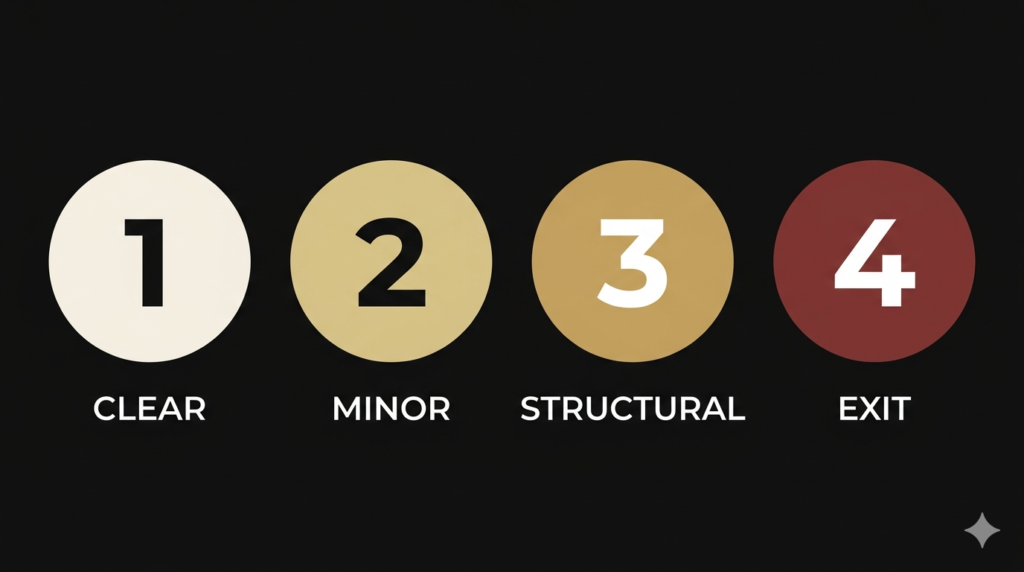
The audit itself is diagnostic. What matters is what you do with the findings. There are really only 4 outcomes, and most businesses land somewhere in the middle.
Outcome 1: Everything Checks Out
This happens less often than agencies would like you to believe, but it does happen. The spend is clean, the reports are accurate, ownership is correct, and the strategy aligns with your business goals. If this is your result, you now have a baseline for future reviews. Run this audit quarterly.
Outcome 2: Minor Issues, Fixable With a Conversation
The most common outcome. You find small reporting gaps, a missing login, or a KPI that needs updating. These are not reasons to fire your agency. They are reasons to have a direct conversation and set new expectations. A good agency will respond positively. If they get defensive, that tells you something too.
Outcome 3: Structural Problems
Account ownership issues, bundled billing, no strategic alignment. These are not quick fixes. They require a formal review meeting, revised contracts, and often a transition plan. This is the point where many founders realise they need independent marketing leadership to manage the agency relationship properly or to bring capabilities in-house. That is the core of our three-pillar methodology: build capability, transfer knowledge, then step away.
Outcome 4: Time to Leave
If the audit reveals deliberate opacity, spend discrepancies, or assets you do not own, start planning your exit. Do not announce it before you have secured access to every account and asset. Get your logins, export your data, and document everything. Then give notice per your contract terms. Rushing this process costs more than doing it properly.
Whichever outcome you land on, the audit has already done its job. You now have a clear picture. And clarity is the prerequisite for every good decision.
Frequently Asked Questions
How long does an independent agency audit take?
Most audits take 2 to 4 hours for a single business with one agency. If you work with multiple agencies across several channels, allow a full day. The 6-point framework is designed so each point can be completed in 15 to 30 minutes.
Do I need marketing experience to audit my agency?
No. The audit framework focuses on verifiable data: spend matches, account ownership, and report accuracy. You do not need to evaluate creative quality or campaign strategy in detail. If the numbers do not match or you cannot access your own accounts, those findings speak for themselves.
Should I tell my agency I am auditing them?
Not initially. The point of an independent audit is to see the picture without the agency framing it for you. Once you have completed the review, you can share your findings and discuss any issues. A trustworthy agency will welcome the transparency.
What if my agency owns my ad accounts?
This is one of the most common and most serious findings. Request a transfer of ownership immediately. In Google Ads and Meta, account ownership can be moved without losing historical data. If the agency refuses, that tells you everything you need to know about the relationship.
How often should I audit my marketing agency?
Run a full audit at least twice per year. Quarterly is better for businesses spending over £10,000 per month on marketing. Between full audits, do a quick monthly check on spend accuracy and report consistency. It takes 20 minutes.
What is the difference between an audit and a performance review?
A performance review looks at results: did the campaigns hit their targets? An audit looks at the underlying mechanics: is the data accurate, do you own your assets, is the reporting honest? You need both, but the audit comes first because it tells you whether the performance data is trustworthy.
Can YLA help with an agency audit?
Yes. While this framework is designed for you to run independently, some businesses want an experienced third party to interpret the findings and recommend next steps. That is exactly what our Fractional CMO service provides: senior marketing leadership that sits on your side and holds partners accountable.
What should I do if the audit reveals serious problems?
Secure access to all your accounts and data before raising the issues with the agency. Export campaign data, creative assets, and audience lists. Then have a direct conversation about the findings. If the problems are structural or the agency is uncooperative, begin planning a transition with a clear timeline.
Ready to Take Control of Your Marketing?
If your audit raised more questions than it answered, that is a sign you need independent marketing leadership. We help founders build the capability to hold agencies accountable, bring the right functions in-house, and stop paying for opacity. The goal is not to need us forever. The goal is to make you so good at this that you never need another agency again.