Last updated: 2026-03-30
TL;DR
- Your ICP is built from your best existing customers, not aspirational ones.
- Analyse closed-won deals for revenue, retention, sales cycle length, and fit.
- Combine firmographic, technographic, and behavioural data into one profile.
- Revisit your ICP every 6 months; markets and your product both change.
- A wrong ICP wastes more budget than bad creative ever will.
Why Most Companies Get Their ICP Wrong
The most expensive mistake in B2B marketing is not bad ad copy, poor landing pages, or even a weak sales team. It is targeting the wrong customers entirely. A wrong ICP wastes more budget than bad creative ever will.
We have seen this pattern repeatedly across 250+ clients. A company defines its ICP based on who they want to sell to, not who actually buys, stays, and generates profit. The result: marketing campaigns that attract leads who churn within 6 months, sales cycles that drag on for quarters, and constant friction between marketing and sales about lead quality.

The root cause is almost always the same. The ICP was created in a strategy workshop based on assumptions, then never validated against real data. Or worse, it was copied from a competitor’s positioning without considering whether the same profile applies.
An Ideal Customer Profile is not a wish list. It is a data-driven description of the type of company (and, in some models, the specific buyer within that company) that gets the most value from your product or service, and delivers the most value back to your business. Both sides of that equation matter.
ICP vs Buyer Persona vs Target Market: Clear the Confusion
These three terms get used interchangeably, and that creates real problems when your team tries to act on them. They are not the same thing.
| Concept | What It Describes | Level of Detail | Example |
|---|---|---|---|
| Target Market | The broad category of companies you could sell to | Low: industry, geography, size range | SaaS companies in Europe with 50-500 employees |
| Ideal Customer Profile (ICP) | The specific type of company that is your best fit | High: firmographics, technographics, behaviour, pain points | B2B SaaS, Series B+, 100-300 employees, uses HubSpot, has an in-house marketing team of 3-8 |
| Buyer Persona | The individual decision-maker within an ICP company | High: role, goals, objections, information sources | VP of Marketing, reports to CEO, cares about pipeline attribution, sceptical of agencies |
Your ICP defines which companies to pursue; your buyer persona defines which people inside those companies to talk to. You need both, but the ICP comes first. If you build personas without an ICP, you end up with detailed profiles of people at companies that will never convert.
This distinction is critical for how you allocate budget. Your digital marketing channels, content strategy, and even your pricing page should all reflect your ICP before they reflect your personas. Get the company-level targeting right first.
Step 1: Mine Your Existing Customer Data
Start with your CRM. Pull every closed-won deal from the past 24 months. If you have fewer than 30 customers, use all of them. If you have hundreds, focus on the top 20% by the metrics that follow.
The Metrics That Matter
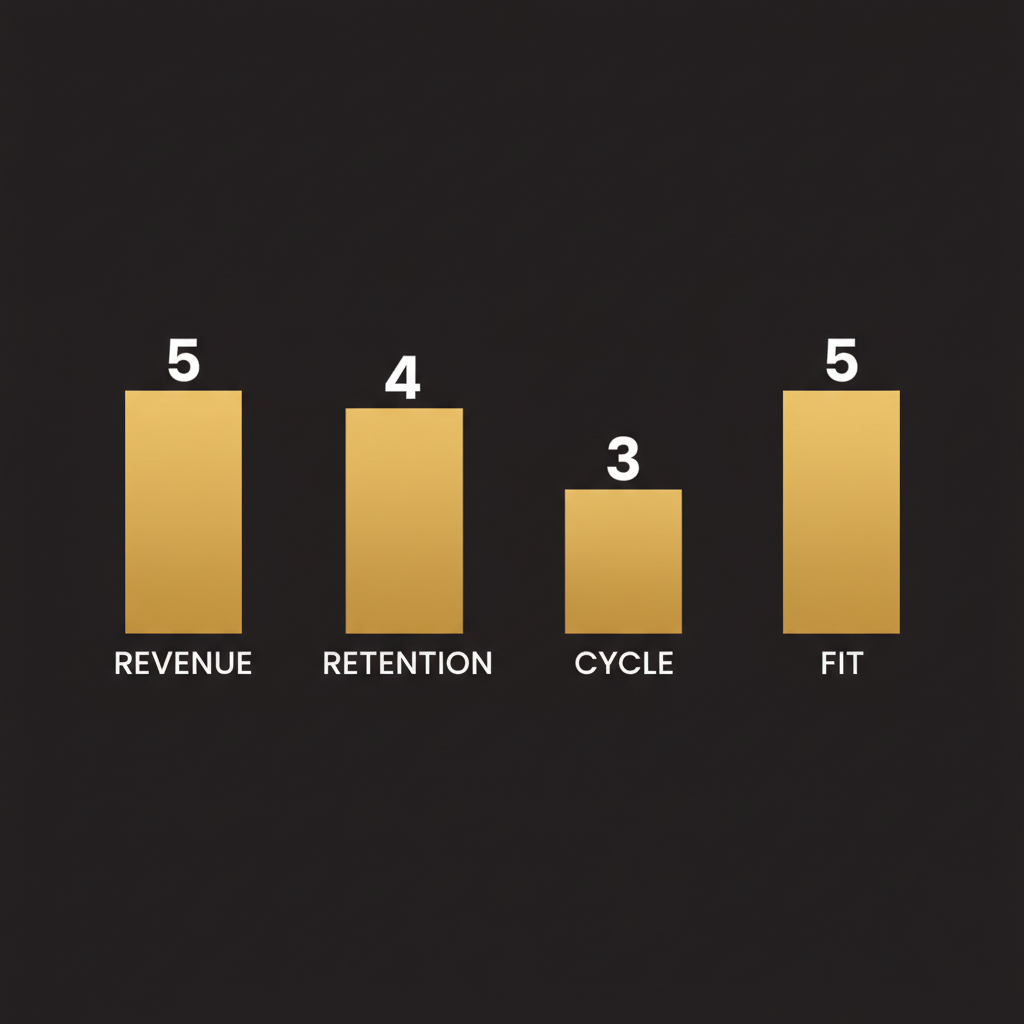
Rank each customer by these four dimensions:
- Revenue contribution: Total contract value and, if applicable, expansion revenue over the customer lifetime. A customer who started at £2,000/month and grew to £8,000/month is more valuable than one who stayed flat at £5,000/month.
- Retention: How long they stay. For SaaS, this is net revenue retention. For services businesses, this is contract renewal rate. According to Bain & Company research, a 5% increase in customer retention can increase profits by 25% to 95%.
- Sales cycle length: Shorter cycles mean lower acquisition cost. If your average sales cycle is 90 days but certain customer types close in 30, that pattern matters.
- Product fit: Do they use the product as intended? Do they submit fewer support tickets? Do they adopt new features? Customers who stretch your product beyond its design are not ideal, even if they pay well.
Score each customer across all four dimensions on a simple 1 to 5 scale. Your ICP candidates are the ones scoring 4 or 5 across the board, not just in one dimension.
What If You Are Pre-Revenue or Early Stage?
If you do not have enough customer data, work with proxies. Analyse your best-fit pilot users, your most engaged free-tier accounts, or the prospects who moved furthest through your sales process. You can also study competitors’ customer bases using tools like SimilarWeb, G2 review data, and LinkedIn Sales Navigator. The ICP will be rougher, but a rough ICP validated quickly beats a precise one built on assumptions.
Step 2: Identify the Common Traits
With your top customers ranked, look for patterns across three categories of data.
Firmographic Traits
These are the company-level demographics:
- Industry and sub-industry (“SaaS” is too broad; “vertical SaaS for healthcare” is useful)
- Company size by employee count and revenue
- Geography and number of locations
- Funding stage or ownership type (private, PE-backed, public)
- Growth trajectory (hiring rate as a proxy, available through LinkedIn data)
Technographic Traits
What technology stack do they use? This is especially relevant in B2B:
- CRM platform (HubSpot, Salesforce, Pipedrive)
- Marketing automation tool
- Analytics setup (GA4, Mixpanel, Amplitude)
- Ecommerce platform, if applicable
Tools like BuiltWith and Wappalyzer let you identify a company’s tech stack without asking them. If you notice that 70% of your best customers use HubSpot, that is a strong ICP signal, not a coincidence.
Behavioural and Situational Traits
This is where most ICP frameworks stop too early. Go beyond static data:
- What triggered them to look for a solution? (New funding round, leadership change, growth plateau, failed agency relationship)
- How did they find you? (Referral, organic search, specific content piece)
- What was their buying committee structure? (Solo founder decision vs. 5-person committee)
- What pain point did they articulate in the first sales call?
The behavioural layer is often more predictive than firmographics alone. Two companies with identical size, industry, and tech stack will have completely different conversion likelihoods depending on whether they just lost a marketing hire or just raised a Series B. According to Gartner’s B2B buying research (2024), 75% of B2B buyers prefer a rep-free sales experience, making it even more important to understand the triggers that put buyers into market in the first place.
Step 3: Build the ICP Document
Combine your findings into a single, usable document. Not a 40-page deck that lives in a shared drive and never gets opened. A single page.
Here is the format we use with clients, adapted from our work in strategy and growth engagements:
| ICP Dimension | Primary ICP | Secondary ICP |
|---|---|---|
| Industry | B2B SaaS (vertical) | Professional services (digital-first) |
| Company Size | 100-500 employees | 50-100 employees |
| Annual Revenue | £5M-£30M | £1M-£5M |
| Funding / Ownership | Series B or later | Bootstrapped, profitable |
| Geography | UK and Western Europe | North America (English-speaking) |
| Tech Stack | HubSpot or Salesforce CRM | Any modern CRM |
| Marketing Team Size | 3-8 people | 1-3 people (founder-led) |
| Trigger Event | Outgrowing current agency or first in-house hire | Post-funding, building marketing function |
| Key Pain Point | Lack of marketing strategy ownership internally | Inability to evaluate agency performance |
| Disqualifiers | No budget approval process; pre-revenue; needs full outsource | Same |
The “Disqualifiers” row is just as important as everything above it. An ICP should tell you who to say no to, not only who to pursue. If you cannot clearly articulate which types of companies are a bad fit, your ICP is not specific enough.
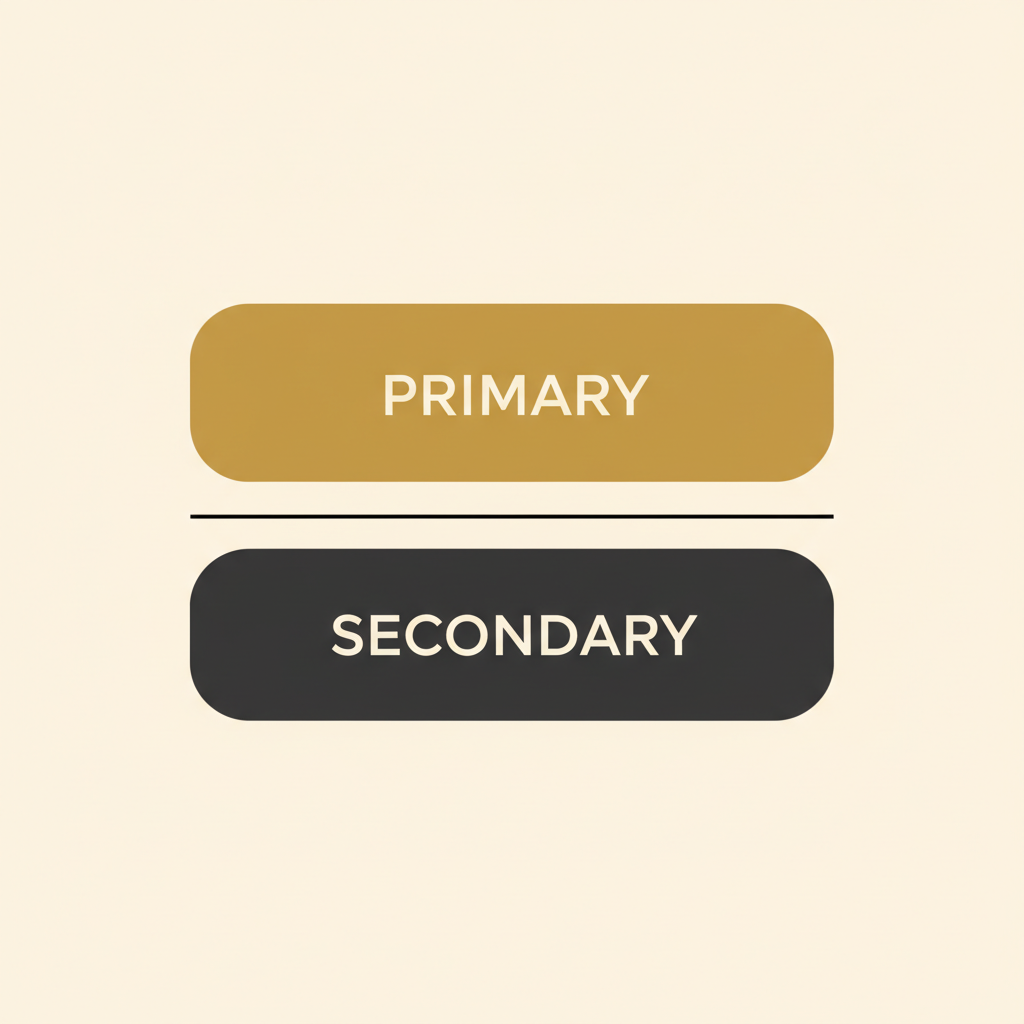
Notice the two-tier structure: Primary and Secondary. Your primary ICP gets the majority of your marketing spend and sales effort. The secondary ICP gets targeted when capacity allows, or when inbound interest from that segment is strong. Trying to serve both equally dilutes everything.
Step 4: Validate with Qualitative Research
Data tells you what happened. Conversations tell you why. After building your draft ICP from CRM data, validate it with 5 to 10 customer interviews.
These are not satisfaction surveys. You are specifically trying to understand:
- What was happening in your business when you started looking for a solution?
- What alternatives did you consider, and why did you reject them?
- Who else was involved in the buying decision, and what were their concerns?
- What would have made you not buy from us?
- What result have you achieved that matters most to your business?
Question 4 is particularly revealing. The answers expose objections your sales team may not be hearing, and disqualification criteria you may not have considered.
If you find that your interview responses contradict your data analysis, that is useful information. Perhaps a customer scored well on retention and revenue, but in conversation reveals they almost churned twice and stayed only because of a specific feature. That changes how you weight their traits in the ICP.
According to the LinkedIn B2B Institute’s research on B2B effectiveness, brand and demand strategies perform best when they target the right accounts from the start. Qualitative validation ensures you are not just targeting companies that look right on paper but miss the situational and emotional factors that drive actual buying behaviour.
Step 5: Activate Your ICP Across the Business
An ICP that sits in a Google Doc is worthless. It needs to become a filter that every team uses daily.
For Marketing
Your ICP should determine your content topics, your ad targeting, your keyword strategy, and which events you attend. If your ICP is Series B SaaS companies with 3-8 marketers, your content should address the specific problems those teams face: attribution across channels, justifying headcount, building repeatable processes. Generic “marketing tips” content attracts generic traffic that does not convert.
This is precisely where content pillars become operational rather than theoretical. Each pillar should map directly to a pain point or aspiration of your ICP.
For Sales
Your ICP should be embedded in lead scoring. Leads matching the primary ICP get prioritised; leads outside the ICP get deprioritised or disqualified. This is not about being elitist. It is about concentrating effort where the probability of a good outcome is highest, for both you and the prospect.
For Product
Feature requests from ICP customers carry more weight than requests from customers outside the profile. If your roadmap is driven by squeaky wheels rather than ICP fit, you will build a product that serves nobody well.
For the Founder or CEO
Every “should we pursue this opportunity?” question gets filtered through the ICP. The power of an ICP is not in who it includes but in who it gives you permission to ignore.
How Often Should You Revisit Your ICP?
Every 6 months, at minimum. Markets shift, your product evolves, new segments emerge. The ICP you built 18 months ago may no longer reflect your best-fit customer.
Specific triggers for an immediate review:
- You launch a new product or major feature that changes your value proposition
- Your churn rate increases by more than 10% quarter over quarter
- Your sales cycle has lengthened noticeably with no clear cause
- You enter a new market or geography
- A major competitor changes their positioning
When we work with clients through our Fractional CMO service, one of the first exercises is an ICP audit. In roughly 6 out of 10 cases, the existing ICP is either outdated, too broad, or was never properly validated in the first place. Correcting it changes everything downstream: messaging, channel mix, budget allocation, hiring priorities.
A report from Demandbase’s State of B2B Advertising (2025) found that companies with well-defined ICPs see 68% higher account win rates compared to those targeting broadly. That figure is directional, not gospel, but the underlying logic is sound: specificity in targeting reduces waste and increases relevance at every stage of the funnel.
Common ICP Mistakes and How to Avoid Them
After working with over 250 clients across 15+ years, these are the ICP mistakes we see most frequently:
| Mistake | Why It Happens | How to Fix It |
|---|---|---|
| ICP is too broad (“any SMB”) | Fear of missing opportunities | Narrow to top-20% customer traits; expand later if data supports it |
| Built on aspirations, not data | Strategy led by opinions rather than CRM analysis | Start with closed-won deals and work backwards |
| Confusing ICP with buyer persona | Templates and blog posts use the terms interchangeably | Define the company first (ICP), then the person (persona) |
| No disqualification criteria | Sales team wants to keep every door open | Define 3-5 explicit disqualifiers and enforce them |
| Never updated | “We did this exercise once” | Calendar a 6-month review cycle with data pull |
| Single-dimension profiling | Only looking at industry or company size | Layer firmographic, technographic, and behavioural traits |
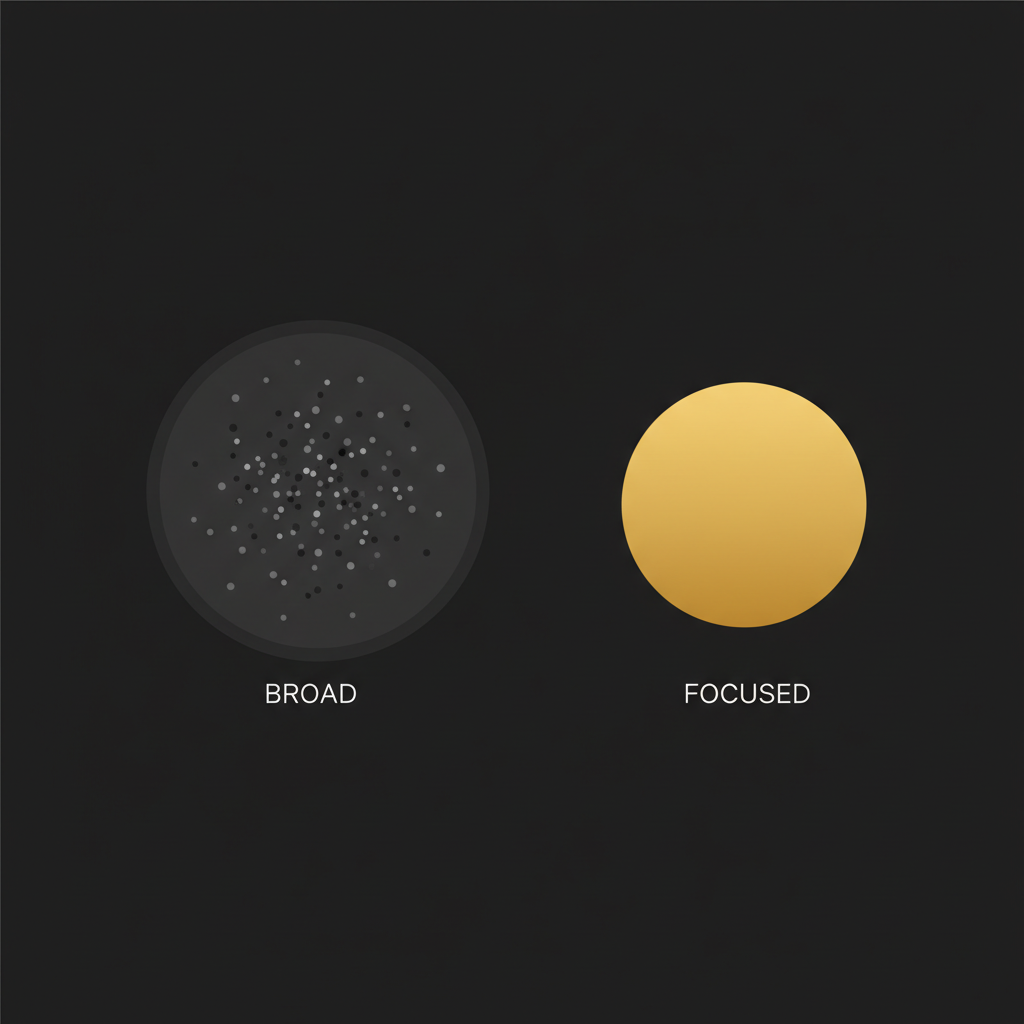
The broadness trap deserves special attention. We worked with a B2B services company that defined their ICP as “companies with 10 to 10,000 employees in any industry.” That is not an ICP. That is a census. When we analysed their CRM, 80% of their revenue came from financial services firms with 200 to 800 employees, and they had a 90% retention rate in that segment versus 45% everywhere else. Narrowing their ICP to that segment reduced their lead volume by 60% but increased their close rate by 3x and cut their churn in half within two quarters.
Frequently Asked Questions
What is an Ideal Customer Profile (ICP)?
An ICP is a data-driven description of the type of company that gets the most value from your product or service and delivers the most value back to your business. It includes firmographic traits (industry, size, revenue), technographic traits (tools they use), and behavioural traits (trigger events, buying process). It is a company-level definition, distinct from a buyer persona which describes the individual decision-maker.
How is an ICP different from a buyer persona?
An ICP defines the type of company you should target. A buyer persona defines the specific person within that company who makes or influences the purchasing decision. You need both, but the ICP must come first. Building personas without an ICP means you risk creating detailed profiles of people at companies that will never convert.
How many ICPs should a company have?
Most companies perform best with one primary ICP and one secondary ICP. More than two splits your focus and dilutes your messaging. If you have identified more than two distinct customer types, prioritise by revenue contribution and retention. You can always expand later as you validate each segment.
How often should I update my ICP?
Review your ICP every 6 months at minimum, using fresh CRM data. Trigger an immediate review if you launch a major new product, see a spike in churn, experience noticeably longer sales cycles, or enter a new market.
What tools can help me build an ICP?
Your CRM (HubSpot, Salesforce, Pipedrive) is the primary source. BuiltWith and Wappalyzer provide technographic data. LinkedIn Sales Navigator helps with firmographic and hiring data. SimilarWeb and G2 are useful for competitive analysis. The most important tool, though, is a spreadsheet where you score your existing customers across revenue, retention, sales cycle length, and product fit.
Can I build an ICP if I am a startup with few customers?
Yes, but your ICP will be a hypothesis rather than a proven profile. Use proxies: your most engaged free-tier users, prospects who moved furthest through your pipeline, and competitor customer data from review sites. Validate quickly by testing messaging and targeting with small budgets, then refine as real customer data accumulates.
What is the biggest mistake companies make with their ICP?
Making it too broad. An ICP that could describe half the companies on LinkedIn is not an ICP. The most common version of this mistake is defining the profile based on who the company wants to sell to rather than analysing who actually buys, stays, and generates profit.
How does an ICP affect marketing strategy?
Your ICP should determine your content topics, ad targeting, keyword strategy, channel mix, and event attendance. It also shapes lead scoring: leads matching the ICP get prioritised, and leads outside it get deprioritised. Every marketing pound should be filtered through ICP fit before it is spent.
Ready to Define (or Redefine) Your ICP?
If your marketing is attracting the wrong leads, the problem is usually upstream. We help B2B companies build data-backed ICPs and align their entire marketing operation around them. No retainers, no dependency; just the capability to do this yourself, permanently.