Last updated: 2026-04-14
TL;DR
- Audience size is a vanity metric dressed up as strategy for most founders.
- Your buyers are probably not scrolling LinkedIn looking for thought leaders.
- Pipeline, positioning, and intent-driven visibility produce revenue. Follower counts do not.
- The “build an audience first” playbook was designed for creators, not operators.
- Specificity and trust outperform reach in every B2B sales cycle.
The Audience-First Playbook Was Not Written for You
Somewhere around 2020, “build an audience” became the default advice for founders. Post on LinkedIn. Start a newsletter. Grow your Twitter following. The logic sounds tight: attention is the new currency, so accumulate as much of it as possible and commercial outcomes will follow.
This advice was designed by creators for creators. People who sell courses, coaching, communities, and info products to other people who want to sell courses, coaching, communities, and info products. It works brilliantly in that closed loop. The audience-first playbook was built for businesses where the audience is the customer.
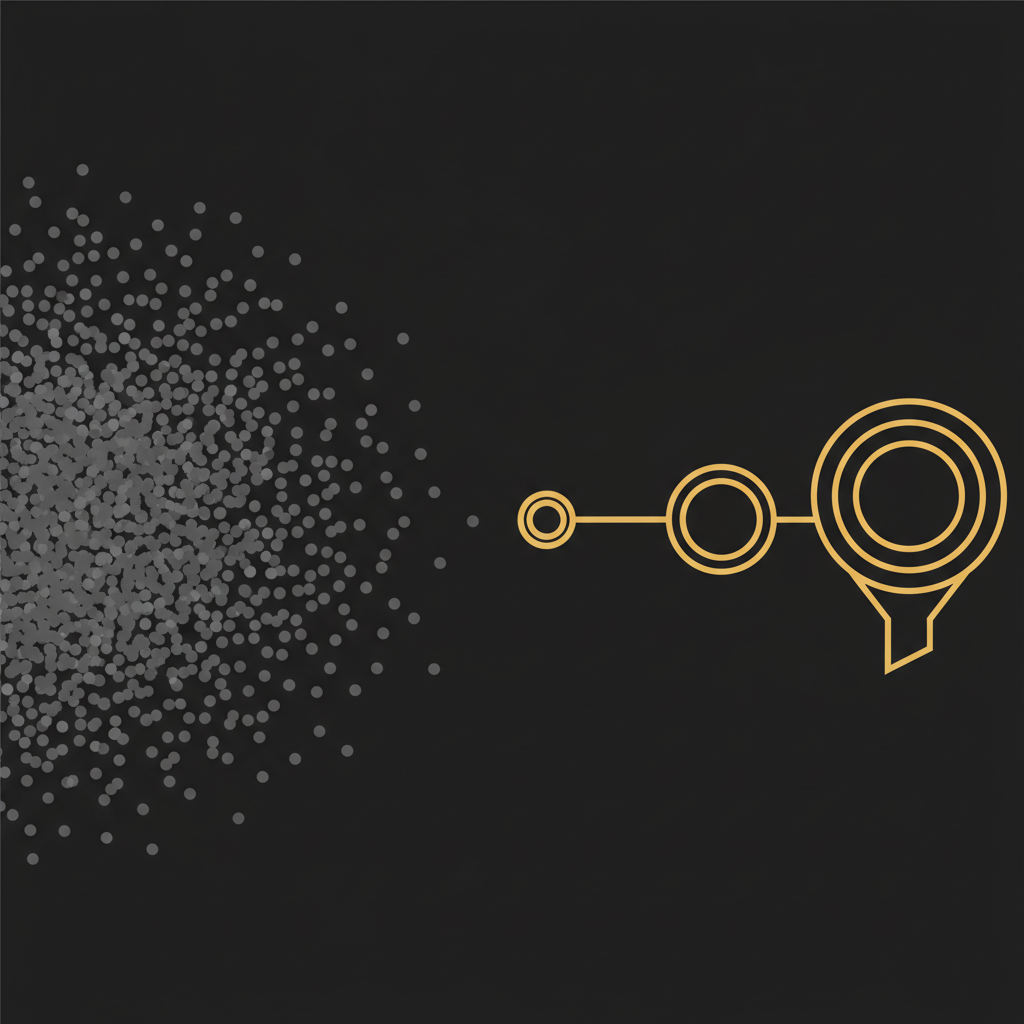
If you sell B2B software, professional services, manufacturing equipment, logistics solutions, or anything where your buyer is a procurement team, a VP of Operations, or a CFO reviewing a shortlist, the audience playbook does not map to your reality. Your buyers are not following founders on LinkedIn for entertainment. They are not subscribing to newsletters for inspiration. They have a problem, they search for a solution, and they evaluate vendors based on specificity, credibility, and fit.
Yet founder after founder pours hours into content calendars, engagement pods, and follower growth because someone with 200,000 followers told them to. The question nobody asks: did that person build their business from the audience, or did they build the audience from the business? The distinction matters enormously.
What Audience Growth Actually Measures
Follower counts measure one thing: how many people clicked a button. They do not measure purchase intent, budget authority, problem urgency, or any of the signals that actually predict revenue.
A founder with 50,000 LinkedIn followers and no pipeline is in a worse position than a founder with 200 followers and 15 active sales conversations. The first has reach. The second has revenue potential. These are not the same thing, and conflating them is expensive.
The Metrics That Matter vs The Metrics That Feel Good
| Metric | What It Actually Tells You | Revenue Correlation |
|---|---|---|
| Follower count | How many people mildly noticed you | Very weak |
| Post impressions | How often the algorithm showed your content | Very weak |
| Engagement rate | How many people reacted, often other founders | Weak |
| Inbound demo requests | Someone with a problem actively seeking your solution | Strong |
| Search visibility for buying keywords | You appear when someone searches with purchase intent | Strong |
| Pipeline velocity | Speed and volume of qualified opportunities | Very strong |
According to LinkedIn’s own B2B Marketing Benchmark report (2024), only 5% of B2B buyers are actively in-market at any given time. That means 95% of your audience, no matter how large, is not ready to buy. Growing that audience from 10,000 to 100,000 does not change the percentage. It changes the number of people ignoring you.
Growing an audience without a conversion mechanism is collecting names on a list that never gets used. And most founders do not have the conversion mechanism, because they skipped straight to distribution without doing the positioning work first.
The Real Cost of Playing the Audience Game
Time is the resource founders undercount. A “simple” LinkedIn strategy of posting 4 times per week, engaging for 30 minutes per day, and nurturing connections requires roughly 8 to 12 hours weekly. For a founder of a company doing £1M to £5M in revenue, that is 8 to 12 hours not spent on product, sales, hiring, or operations.
We see this pattern regularly through our Fractional CMO work. A founder comes to us after 6 to 12 months of consistent content creation, frustrated that it hasn’t translated into commercial outcomes. Their content is fine. Sometimes it is genuinely good. But they built distribution before they built positioning, and now they have an audience that likes their posts but does not buy their product.
The cost is not just the hours. It is the opportunity cost of those hours, plus the psychological cost of measuring your marketing success by likes and follows rather than pipeline and revenue. That second cost is subtle but corrosive. It trains founders to optimise for what gets engagement (hot takes, personal stories, inspirational platitudes) rather than what gets customers (specific problem articulation, clear differentiation, evidence of competence).
The Content Treadmill Problem
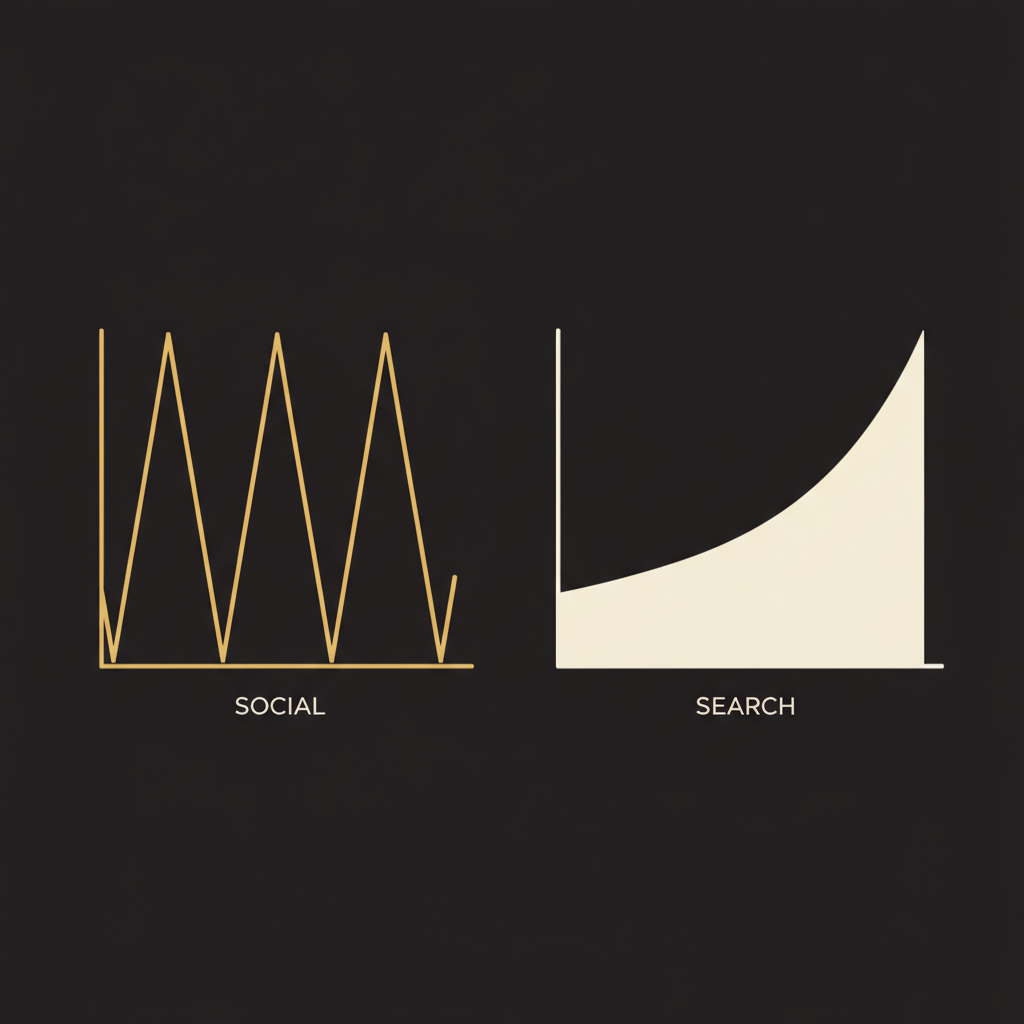
Social media algorithms reward recency and frequency. The moment you stop posting, your visibility drops. This creates a treadmill with no off switch. Contrast this with search-driven content, which compounds over time. A blog post that ranks for a high-intent keyword delivers qualified traffic for months or years without additional effort. A LinkedIn post from 3 weeks ago delivers nothing.
HubSpot’s 2025 State of Marketing report found that blog content older than 6 months drives 38% of total organic traffic for B2B companies. Social content older than 48 hours drives close to zero. If your time is limited, and as a founder it is, the compounding asset wins every time.
Who the Audience-First Model Actually Works For
To be precise about this: audience-first is not universally wrong. It is wrong for most founders. There are specific conditions under which it makes sense.
| Condition | Audience-First Makes Sense | Audience-First Is a Distraction |
|---|---|---|
| Your buyers are other founders or marketers | Yes, they are on the platforms | No, buyers are elsewhere |
| Your price point is under £500 per transaction | Volume attention can convert | Enterprise deals need specificity, not volume |
| Your product is self-serve | Attention can drive sign-ups directly | Complex sales cycles require trust |
| You are the product (coaching, speaking, courses) | Personal brand is the business | The company brand matters more |
| Your sales cycle is under 2 weeks | Impulse and social proof work | Long cycles need nurture infrastructure |
If you are a SaaS founder selling a £25/month tool to solopreneurs, audience-first can work. If you are running a B2B services firm selling £50,000+ annual contracts to mid-market companies, audience-first is almost certainly a distraction. Your buyer is a Finance Director or a Head of IT. They are not engaging with your LinkedIn posts. They are running a procurement process.
What to Build Instead of an Audience
If audience is the wrong primary goal, what replaces it? Three things: positioning, intent capture, and pipeline infrastructure. These are not glamorous. They do not produce vanity metrics you can screenshot. They produce revenue.
1. Positioning That Repels the Wrong Buyers
Most founders have a positioning problem, not a distribution problem. They can describe what they do but cannot articulate why a specific buyer should choose them over 4 similar options. Before you create a single piece of content, you need to be able to complete this sentence: “We are the only [category] that [specific differentiator] for [specific buyer].”
If you cannot fill in those blanks with something concrete and verifiable, no amount of audience growth will compensate. You will attract a crowd and convert nobody, because your value proposition is too vague to trigger a buying decision.
This is where our three-pillar methodology starts. Positioning comes before distribution, always. Getting this right is the single highest-leverage activity for any founder spending time on marketing.
2. Intent Capture Over Attention Capture
Attention capture means getting noticed by people who are not looking for you. Intent capture means being found by people who are actively looking for what you sell. The difference in conversion rate between these two groups is staggering.
According to WordStream’s 2024 PPC benchmarks, the average conversion rate from paid search (intent-driven) is 4.4% across industries. The average conversion rate from paid social (attention-driven) is 1.1%. That is a 4x difference before you account for lead quality.
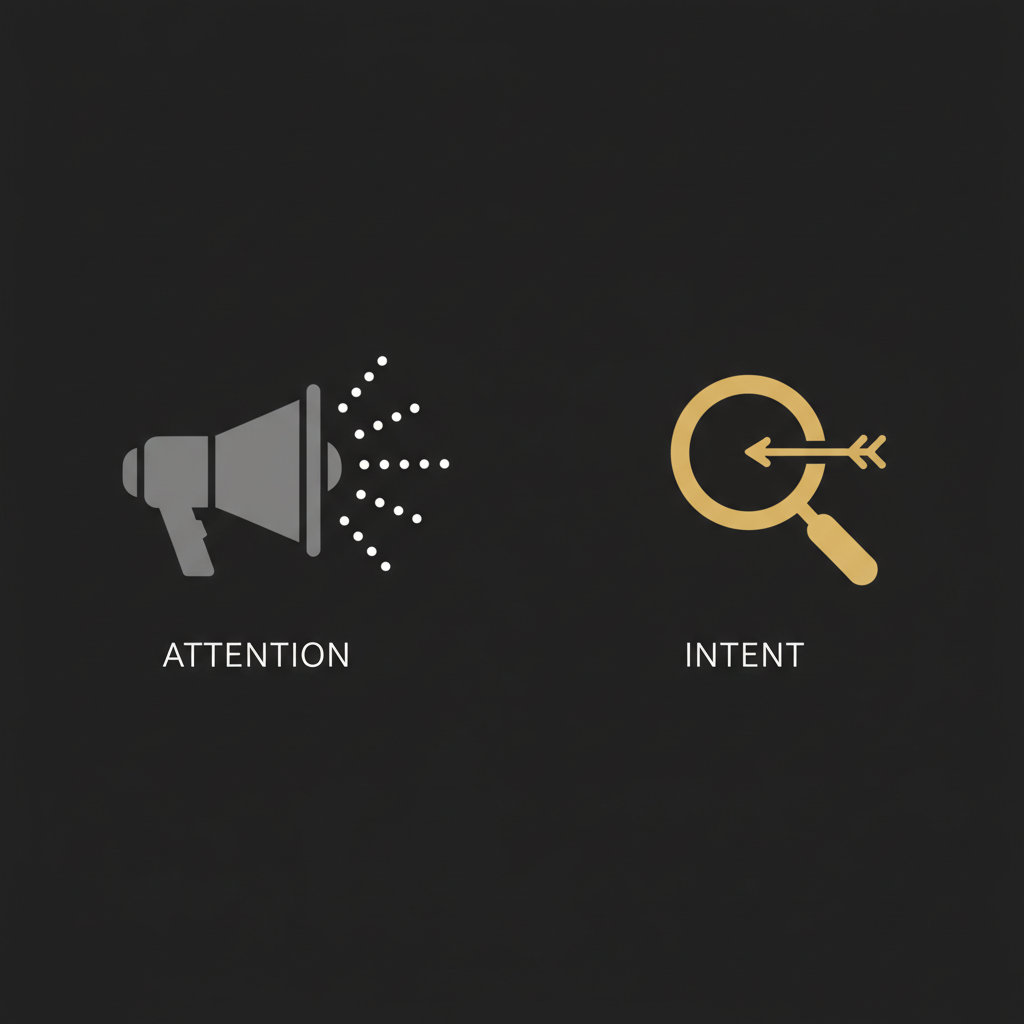
For organic channels, the pattern holds. BrightEdge’s research (2024) shows that organic search drives 53% of all website traffic, and that traffic converts at significantly higher rates than social referral traffic because the visitor arrived with a question they want answered.
Intent capture is about search and generative engine visibility, strategic paid search, and content that answers the exact questions your buyers ask before they buy. It is not about being famous. It is about being findable at the moment of need.
3. Pipeline Infrastructure That Compounds
A pipeline is not a CRM with names in it. A pipeline is a system where qualified prospects enter, move through defined stages, and either convert or are recycled for future nurture. The components are specific:
- Content that ranks for high-intent keywords related to your solution category.
- A clear conversion path from that content (not “subscribe to my newsletter” but “book a conversation about your specific problem”).
- A follow-up sequence that adds value rather than just asking for the sale.
- Sales collateral that addresses specific objections your buyers have.
Each of these assets compounds over time. A blog post that ranks for “how to choose a [your category] vendor” will deliver qualified leads for years. A LinkedIn post that gets 500 likes delivers dopamine for a day.
The Founder’s Content Hierarchy
If you have 10 hours per week for marketing (which is already generous for a founder running a growing company), here is how to allocate them for maximum commercial impact.
| Priority | Activity | Hours/Week | Why It Matters |
|---|---|---|---|
| 1 | High-intent search content (blogs, landing pages) | 4 | Compounds over time, captures active buyers |
| 2 | Sales enablement content (case studies, comparisons) | 3 | Shortens sales cycles, builds credibility |
| 3 | Direct outreach and relationship building | 2 | Personal connection at scale with qualified targets |
| 4 | Social posting (repurposed from above) | 1 | Maintaining presence, not building audience |
Notice that social media is last, not first. And when it does appear, it is repurposed content from activities that serve a commercial purpose. You are not creating for the platform. You are distributing what already exists.
The best use of social media for most founders is to support sales conversations already happening, not to start new ones from scratch. When a prospect is evaluating you, they will check your LinkedIn. Having substantive, specific content there matters. Having 50,000 followers does not.
This hierarchy is also what we recommend when working through strategy and growth engagements. The founders who resist the urge to chase reach and instead invest in specificity consistently outperform those who post every day to an audience that never buys.
The Visibility You Actually Need
There is a version of this argument that ends with “so build a smaller, better audience instead.” That is not this argument. Reframing the same goal with a quality modifier does not change the fundamental problem, which is that audience size (of any size) is a proxy metric, not a business outcome.
What founders need is not an audience. It is visibility with the right people at the right time about the right problem. That is a fundamentally different thing.

An audience is a group of people who have chosen to follow you. Visibility is the ability to appear in front of a potential buyer at the moment they are looking for a solution. You do not need followers for visibility. You need:
- Search rankings for the terms your buyers actually use when they have the problem you solve.
- Presence in AI-generated answers when your product category comes up (this is where GEO becomes relevant).
- Case studies and proof points that circulate in the communities where your buyers spend time.
- Referral relationships with people who serve the same buyer for different needs.
None of these require a large following. All of them require clear positioning, specific content, and patience. Forrester’s 2024 B2B Buying report found that 62% of B2B buyers make their shortlist before ever contacting a vendor. If you are not visible during that research phase, no amount of LinkedIn followers will save you. Your buyers made their decision before you had a chance to pitch.
Stop Measuring What Makes You Feel Good
The appeal of audience metrics is that they are visible, countable, and socially validating. Every new follower is a tiny hit of progress. Revenue metrics are messier. Pipeline takes months to build. Positioning work produces no immediate external feedback. The compounding blog post does nothing for weeks, then quietly becomes your top source of qualified leads.
This is exactly why audience growth is so seductive for founders. It feels like marketing. It looks like marketing from the outside. Other founders see your growing follower count and assume you are doing well. But feelings and appearances are not strategy.
The founders we work with who produce the best commercial outcomes from their marketing share one trait: they are willing to do the invisible work. They invest in positioning before distribution. They write content for buyers, not peers. They measure pipeline contribution, not impressions. And they resist the daily temptation to check how many people liked their latest post.
Your marketing should produce customers. If it is producing followers instead, something is wrong with the strategy, not the execution. More effort in the wrong direction just gets you further from where you need to be.
Frequently Asked Questions
Is building an audience always a waste of time for founders?
No. If your buyers are other founders, your price point is low, and your product is self-serve, audience building can work. For most B2B founders selling to non-founder buyers with longer sales cycles, it is a misallocation of time relative to other activities.
Should I stop posting on LinkedIn entirely?
Not necessarily. Social presence has value as a credibility signal when prospects research you. The problem is when social content creation becomes your primary marketing activity rather than a supporting one. Keep posting, but repurpose from higher-priority content rather than creating for the platform first.
What should I measure instead of follower growth?
Inbound demo requests, search visibility for buying-intent keywords, pipeline velocity, conversion rate from content to sales conversation, and revenue attributed to marketing channels. These are harder to track and less satisfying to watch, but they correlate directly with business outcomes.
How long does intent-driven content take to produce results?
Search-driven content typically takes 3 to 6 months to rank and generate consistent traffic. The upside is that it compounds: a post that ranks well continues to deliver qualified visitors for years without additional effort, unlike social content which decays within 48 hours.
Can I hire someone to build my audience while I focus on the business?
You can delegate content creation, but if the content is not built on solid positioning and aimed at your actual buyers, you are paying someone to produce vanity metrics. Get the positioning and intent-capture strategy right first, then delegate execution.
What is intent capture and how is it different from audience building?
Audience building means attracting people who are not currently looking for your solution and keeping their attention. Intent capture means being visible to people who are actively searching for what you sell. The conversion rates differ by 4x or more because the prospect’s mindset is completely different.
What does good positioning look like for a B2B founder?
You should be able to say: “We are the only [category] that [specific differentiator] for [specific buyer].” If you cannot complete that sentence with concrete, verifiable claims, your positioning needs work before you invest in any distribution channel.
How does generative AI change this advice?
AI-generated answers in search make intent capture even more important. When tools like ChatGPT or Gemini answer buyer questions, they pull from well-structured, authoritative content. Having 100,000 followers does not influence AI citations. Having specific, well-sourced content about your category does.
Ready to Build Pipeline Instead of Followers?
If your marketing produces likes but not leads, the strategy needs rethinking. We help founders build positioning, intent capture, and pipeline infrastructure that compounds into revenue.